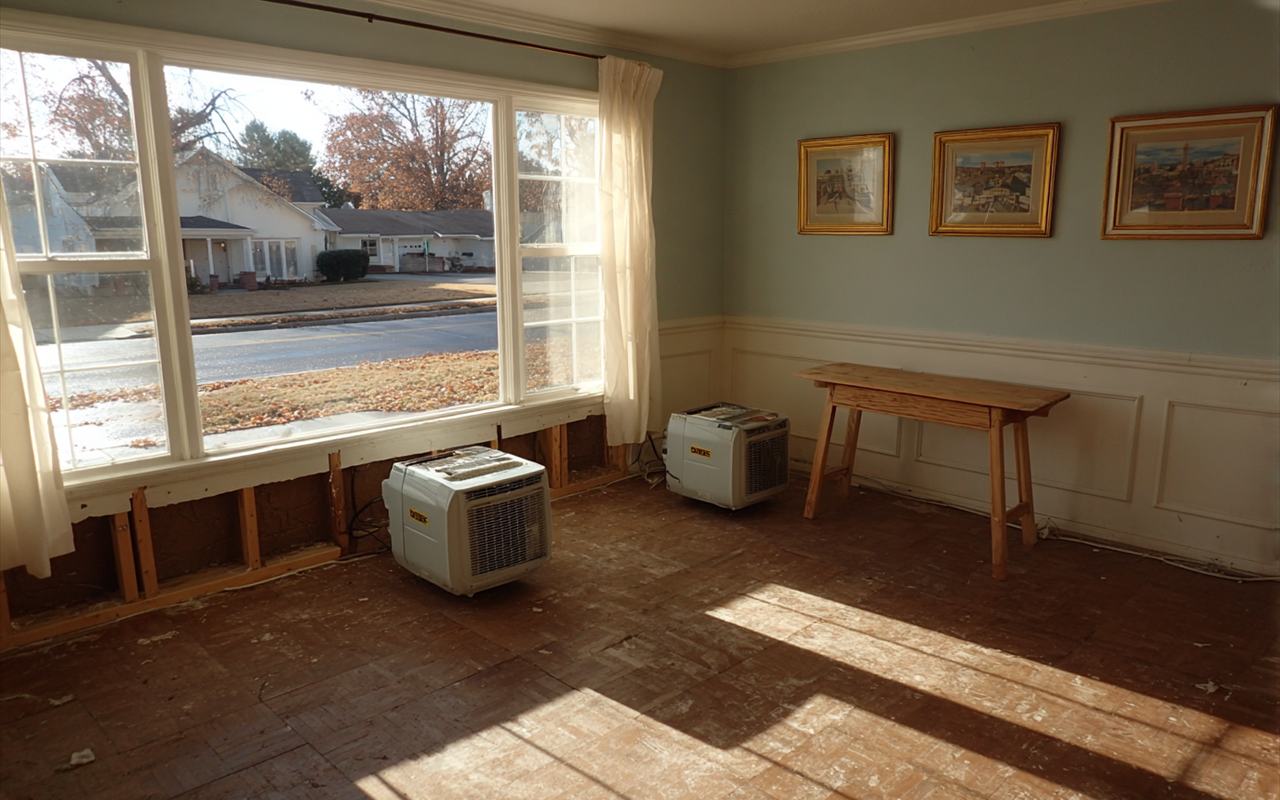
Two neighbors in the same subdivision, in houses built by the same builder in the same year, each have a washer hose burst on the same afternoon. One ends up with a short job and a modest bill. The other has weeks of work and a bill many times larger. Nothing about either restoration company explains it. The difference is in the water: where it went, how long it sat, and what it soaked into.
This note explains those factors. It doesn't list prices, because they depend on the house and the company, and any number here would be wrong for yours.
Factor 1: How Long the Water Ran
The single biggest factor is time. A hose that bursts while someone's home gets shut off in minutes. The same hose bursting while the owners are at work, or away for a weekend, runs for hours. More water means more wet area, more material removed and more drying equipment for more days.
Factor 2: Where It Went
Water spreads differently depending on what it lands on:
- On an upper floor, it goes down: subfloor, ceiling below, the room below that.
- Over a crawlspace, it goes through the subfloor onto the insulation and the vapor barrier, adding work under the house.
- On a slab, it spreads sideways under the flooring and into the bottom of every wall it reaches.
- Into a wall cavity, it wicks up and along the drywall where it can't be seen.
The neighbor whose laundry room sat over the kitchen got two floors wet. The one whose laundry was in the garage got a wet garage wall.
Factor 3: What It Soaked Into
| Material | Why it changes the bill |
|---|---|
| Carpet pad | Almost always replaced once soaked |
| Laminate | Usually replaced; it swells and doesn't recover |
| Hardwood | Sometimes saved with careful drying, which takes time |
| Vinyl plank | The planks often survive, but they may have to come up so the subfloor dries |
| Drywall | Firm board may dry in place; soft board comes out and has to be replaced and finished |
| Insulation | Soaked insulation usually comes out and gets replaced |
| Cabinets | Base cabinets with particleboard often swell; removing and replacing them adds a lot |
| Tile | Usually survives on a slab; grout and backer may not |
Factor 4: How Clean the Water Was
Water from a supply line starts clean. Water from an overflowing toilet, a backed-up drain or outside surface water does not. The dirtier the water, the more porous material has to be removed instead of dried, and the more cleaning comes before drying.
Factor 5: What Had to Be Opened to Reach It
Some wet areas are easy to get to. Others sit behind tile, under cabinets, behind a tub surround or above a finished ceiling. The more that has to be removed to reach the water, the more there is to put back afterward.
Factor 6: How Long Drying Takes
Drying is measured, not guessed. Equipment stays until the readings say dry. A short clean leak on a slab may dry in a few days. A crawlspace house in irrigation season, with groundwater slowing everything, may take longer. Every extra day of equipment shows up on the bill.
Factor 7: The Restoration Side
Mitigation, the extraction and drying, is one part. Restoration, putting the house back, is another, and it varies with the finishes: matching a ceiling texture, sourcing flooring to match what stayed, replacing custom trim. The more the house has to match, the more the restoration costs.
Factor 8: What's Under the Floor
The same leak behaves differently over a crawlspace, a slab or a basement. Over a crawlspace, the job often includes work under the house: pulling wet insulation, replacing a soaked vapor barrier and drying the joists, which adds equipment and visits. On a slab, more flooring may come up because water spreads sideways under it. In a finished basement, the bottom of every wet wall may have to be opened. What you see upstairs can look identical in all three. What it usually means for the bill can be very different. That's why a company asks about the foundation on the first call. More: crawlspace, slab or basement.
What Keeps a Job Small
- knowing where the main shutoff and each fixture valve are, and using them fast
- calling right away instead of waiting to see if it dries
- moving belongings off wet floors
- photographing everything before anything moves
- telling the company what's under the floor: crawlspace, basement or slab
Questions
Why won't a company give a price over the phone?
Because the factors above can't be seen over the phone. Readings on site show how far the water went.
Is drying cheaper than replacing?
Often, when the material can be saved. But drying a material that can't be saved costs time and then it gets replaced anyway. The readings and the material decide.
Does insurance pay for all of it?
It depends on your policy and the cause. Sudden leaks are often covered; gradual leaks and groundwater often aren't.
Around Meridian
Long open floors in Lochsa Falls and river-adjacent lots in Garden City show how much the house itself changes the job. The steps of the work are on restoration and mitigation.
Moisture Readings and Drying Logs: How "Dry" Gets Decided
The numbers behind the fans, and why the room feeling dry isn't enough.
Builder Warranty, HOA or Homeowner: Who Handles Which Leak
A decision table for newer subdivisions.